
Cleaning Up a Messy Google Ads Account for a Private Investigator in Australia
Back in August, I reviewed the Google Ads account of a private investigator in Australia.
They were spending about $6,000 AUD a month. On the surface, it looked like they were doing “a lot.”
- Three search campaigns split by state. Each one had 8–10 ad groups, with budgets spread thin just $40 to $60 a day per campaign.
- One catch-all Performance Max campaign, with a handful of generic images, generic ad copy, long headlines written like short ones that failed to use the 90-character space, and descriptions that repeated headline-style phrases instead of giving fuller context or benefits
- Inside each campaign, 8–10 ad groups stuffed with 20+ keywords each.
- And to make things worse, the Search Network was left turned on. That meant ads were being sprayed across random partner sites, which explained the flood of low-quality leads.
Plenty of moving parts. But no real direction.
The budget was chopped up into little pieces. The account structure felt dated. And the creative assets didn’t give the algorithm much to work with. It was all over the place like a garage crammed with boxes where you can’t even remember what’s inside.
The Hidden Cost of Too Many Ad Groups and Keywords
1. Too many ad groups for the budget
With only $40–$60 per campaign, splitting it across 8–10 ad groups means each ad group only gets a few dollars a day. That’s not enough for Google’s algorithm to gather meaningful data, so learning drags out and results stay inconsistent.
2. Keyword stuffing dilutes performance
Packing 20+ keywords into each ad group is the old “kitchen sink” approach. It makes matching messy, spreads clicks across too many terms, and prevents you from seeing which search terms actually convert. Best practice now is tightly themed ad groups with fewer, higher-intent keywords.
3. Misaligned with how Google optimizes
Modern Google Ads relies on machine learning. It wants clear signals: one focused ad group with enough budget and clean conversions. When you overload with keywords and fragment the budget, you’re giving Google muddy signals. The algorithm can’t optimize properly.
4. Wasted impressions and higher CPLs
Low budget + too many keywords = you’re showing ads in a scattered way without enough volume on any one keyword. That usually leads to low impression share on your best queries, wasted spend on irrelevant ones, and poor lead quality.
Cutting Back to Grow
So what did I change?
First, I went back to the search campaigns. I pulled every converting search term since January. The queries that actually turned into business. Then I rebuilt from scratch:
- 1–2 ad groups per campaign, only where it made sense
- 6–8 tightly focused keywords per ad group, aligned with their core services (not trying to cover everything under the sun)
- Search Network turned off, so the budget stopped bleeding into random partner sites
I also added conversion values. We know phone conversations are more valuable than form fills, so I set calls as the higher-value action and switched bidding to Maximize Conversion Value. That way, the algorithm wasn’t just chasing leads—it was chasing the right ones.
Then I turned to Performance Max. Instead of letting a half-baked setup run, we rebuilt it properly:
- Created 20 new images in 3 dimensions (so the campaign actually had variety to test) for each asset group
- Wrote real long headlines that used the full 90 characters, not short blurbs
- Rewrote descriptions as actual descriptions, not more headlines
- Configured audience signals so the campaign knew where to start
- Split everything into three asset groups, each tied to a core service
That’s it. No new budget. No magic tricks. Just a cleaner structure, better inputs, and bidding focused on what mattered most.
A week later, the client messaged me:
“We had 11 calls in one day, on a Saturday! That hasn’t happened in months!”
What the Numbers Really Say
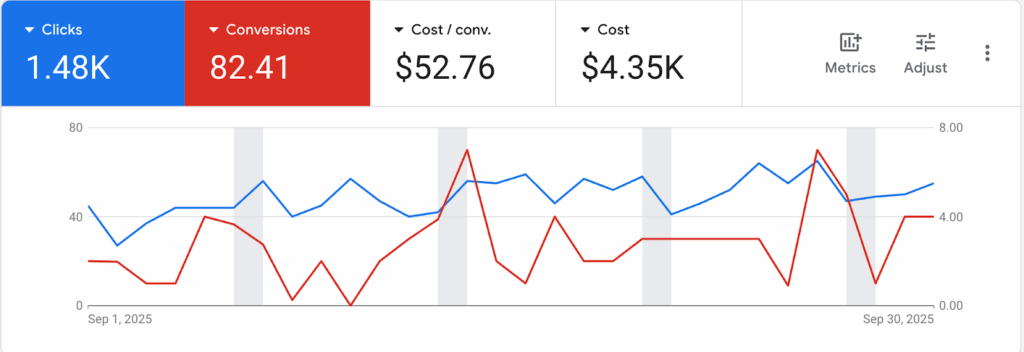
Fast forward to September—our second month managing the account.
We hopped on a call to review the types of clients they actually closed. Since they’re still moving from an old CRM to HubSpot, we had to manually trace deals back to ads.
Here’s what we found:
- $30K in surveillance projects
- $10K in cheating partner and dating cases
- $5K in locating individuals owing money
- $1.7K in bug sweeps
- Half a dozen hourly projects starting at $850
All from $4,350 in ad spend.
Why This Matters
Most teams think growth comes from adding more campaigns or more budget.
But more isn’t always better.
What worked here wasn’t complexity. It was simplicity.
By removing clutter, every dollar helped the algorithm focus on the right people. And with offline conversions fed back into the platform (once HubSpot is fully up), it’ll get even sharper.
The Bigger Picture
Ad platforms will always spend your money. That part is easy.
What’s hard is making sure they spend it on the right people, for the right services, at the right time.
And sometimes, the fix isn’t more, it’s less.